


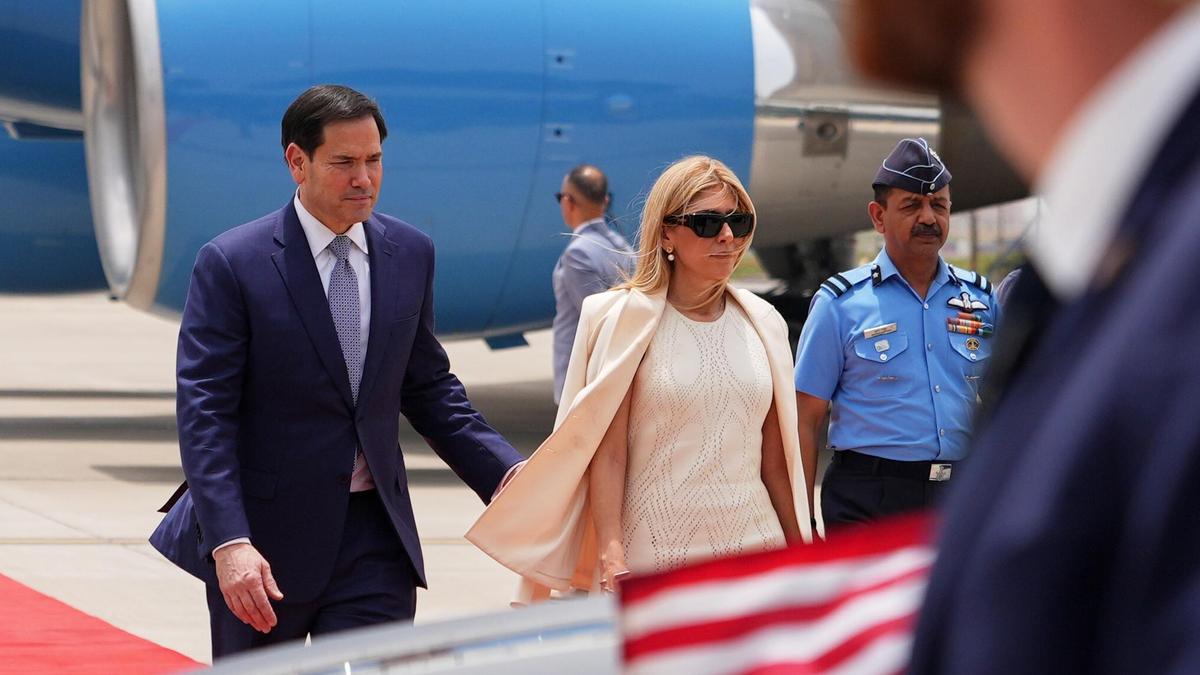
In a visit carrying both strategic weight and deep symbolic significance, U.S. Secretary of State Marco Rubio touched down in Kolkata on Saturday, kicking off a four-day diplomatic tour of India that is being watched closely in both Washington and New Delhi. It is Rubio’s first trip to India in his capacity as America’s top diplomat, and the agenda — spanning trade, energy, technology, defence, and the Quad — signals just how much both nations are investing in a relationship they now openly describe as one of the defining partnerships of the 21st century.
A Historic Arrival in the City of Joy
Rubio became the first U.S. Secretary of State to set foot in Kolkata since Hillary Clinton visited the city in May 2012 — a 14-year gap that makes the choice of Kolkata as his entry point all the more deliberate. The city, India’s cultural and intellectual heartland, has long been seen as a barometer of the country’s political winds. His arrival comes only weeks after West Bengal witnessed a historic political transformation with the installation of a BJP-led government, lending the visit an added layer of political resonance.
Rubio arrived at Netaji Subhash Chandra Bose International Airport alongside his wife Jeanette, where U.S. Ambassador to India Sergio Gor welcomed him with notable enthusiasm. “Secretary Marco Rubio has landed in Kolkata. This is his first trip to India. Later today, we will call on Prime Minister Narendra Modi in New Delhi. Trade, Technology, Defence, QUAD, and many other items to discuss and advance over the next few days!” Gor wrote on X.
A Sentimental Stop: Mother House
Before heading to New Delhi for high-level political engagements, Rubio made a deeply personal detour — visiting Mother House, the Kolkata headquarters of Saint Teresa’s Missionaries of Charity, as well as a children’s home in the city. The visit was more than optics. For a diplomat in a high-stakes relationship that has suffered periodic strain, beginning the trip in a place associated with compassion and shared humanity sends a message: that American engagement with India is not purely transactional but grounded in values both nations profess to hold dear.
The Four-City Itinerary
From Kolkata, Rubio’s schedule takes him through Agra, Jaipur, and finally New Delhi — a journey that blends cultural immersion with intensive diplomacy. The full tour spans May 23 to 26, and each stop carries its own significance. Agra and Jaipur represent India’s civilisational depth; New Delhi is where the hard negotiations will happen. Together, they suggest a visit crafted to communicate respect for India as a whole — its history, its people, and its government.
A Relationship That Needed Tending
The backdrop to this visit is not an easy one. India-U.S. ties hit a turbulent patch last year following Washington’s imposition of punitive tariffs on Indian goods and President Trump’s controversial claims about his role in de-escalating the India-Pakistan military standoff. New Delhi’s strategic establishment grew visibly uneasy — more cautious about Washington than at any point in recent memory.
The Quad itself — the four-nation security grouping of India, the U.S., Australia, and Japan — faced uncertainty after a planned leaders’ summit was cancelled and questions emerged about whether America had shifted its strategic focus elsewhere. Against this backdrop, Rubio’s visit is widely interpreted as an attempt by Washington to repair the relationship and restore confidence in its reliability as a long-term partner.
Groundwork was carefully laid in advance. In April, Foreign Secretary Vikram Misri met Rubio at the White House, where both sides reviewed the bilateral partnership with emphasis on trade, critical minerals, defence cooperation, and the Quad framework. That preparatory session gave both governments a running start before Rubio landed on Indian soil.
The Agenda: Trade, Energy, Technology, Defence
The pillars of discussion during this visit are broad and consequential.
Trade: India and the U.S. have been working toward resolving longstanding tariff disputes. Earlier in the year, Washington agreed to reduce tariffs on Indian goods to 18 percent — a significant concession that signalled a thaw. This visit is expected to build on that momentum, with both sides looking to formalise further trade cooperation and remove bottlenecks that have slowed commercial engagement.
Energy: Perhaps the most commercially significant dimension of Rubio’s visit is Washington’s push to dramatically expand energy exports to India. Before departing for Sweden and India, Rubio told reporters plainly: “Well, we want to sell them as much energy as they’ll buy. And obviously, you’ve seen I think we’re at historic levels of US production and US export.” He also engaged directly on the question of energy price pressures caused by the closure of the Strait of Hormuz, describing India as a “great partner” and expressing confidence in expanded cooperation.
Technology and Critical Minerals: Both governments have identified critical minerals — lithium, cobalt, rare earths — as a strategic priority, given their centrality to defence systems, electric vehicles, and semiconductor supply chains. Discussions on formalising cooperation on the exploration, mining, and processing of these minerals are expected to advance during this visit.
Defence: Defence cooperation has long been a strong suit of the bilateral relationship. The two sides are expected to discuss advancing joint manufacturing, expanding technology transfers, and deepening interoperability between their armed forces — conversations that have gained urgency in the wake of heightened tensions across the Indo-Pacific.
The Quad: On May 26, Rubio will attend the Quad foreign ministers’ meeting in New Delhi, chaired by External Affairs Minister S. Jaishankar, alongside Australian Foreign Minister Penny Wong and Japanese Foreign Minister Motegi Toshimitsu. The gathering is expected to reaffirm the Quad’s commitment to a free and open Indo-Pacific and address the evolving security environment in the region.
How This Visit Could Boost the Indian Economy
Beyond the diplomatic symbolism, this visit has real and potentially transformative implications for the Indian economy. Here is what is at stake across key sectors:
Cheaper and More Stable Energy Supply
India is one of the world’s largest consumers of energy and has historically been dependent on West Asian oil — a vulnerability that has been sharply exposed by the recent closure of the Strait of Hormuz. A structured arrangement to import significantly more American liquefied natural gas (LNG) and crude oil would not only diversify India’s energy mix but also reduce its exposure to volatile geopolitical flashpoints. Lower energy input costs translate directly into reduced manufacturing costs, lower inflation, and improved competitiveness for Indian industry. For ordinary Indian consumers, the knock-on effect could be reduced electricity bills and more stable fuel prices at the pump.
Tariff Relief and Export Growth
The earlier agreement bringing U.S. tariffs on Indian goods down to 18 percent was a meaningful first step, but there is scope for much further reduction. India’s export-oriented sectors — pharmaceuticals, textiles, gems and jewellery, engineering goods, IT services — stand to gain significantly if trade barriers continue to fall. A more favourable tariff environment could open up larger market access for Indian manufacturers in the United States, potentially generating hundreds of thousands of jobs in export-linked industries across states like Gujarat, Tamil Nadu, Maharashtra, and Telangana.
Technology Transfer and the Semiconductor Play
India’s ambition to build a world-class semiconductor manufacturing ecosystem aligns closely with America’s own interest in de-risking supply chains away from China. Enhanced U.S.-India cooperation in critical and emerging technologies — semiconductors, artificial intelligence, quantum computing, and advanced manufacturing — could unlock significant foreign direct investment into India’s technology sector. U.S. firms looking to diversify their supply chains are already eyeing India; deeper diplomatic engagement can accelerate that process and push investment decisions across the line.
Critical Minerals: The Battery Economy
India possesses reserves of several minerals that are essential to the global clean energy transition, and the country is working aggressively to develop its mining and processing capabilities. A formal U.S.-India critical minerals partnership would attract American capital and technology into Indian mining projects, create upstream and downstream industrial jobs, and position India as a key node in global battery and electric vehicle supply chains. This is not a distant prospect — it is a near-term economic opportunity if the diplomatic framework is secured.
Defence Manufacturing and Jobs
The push for deeper defence cooperation is not just a security conversation — it is an economic one. Under India’s Defence Production Policy, American defence companies are increasingly expected to invest in local manufacturing, joint ventures, and technology sharing with Indian partners. Every fighter jet component, naval system, or drone platform co-produced in India represents jobs, skills transfer, and industrial capacity built on Indian soil. The expansion of defence ties discussed during Rubio’s visit could unlock billions of dollars of defence-linked investment over the coming decade.
Attracting Foreign Direct Investment
The most immediate economic signal Rubio’s visit sends is to the global investor community: that the world’s most powerful nation views India as a strategic and commercial priority. Diplomatic momentum of this kind consistently correlates with upticks in FDI interest. American corporations — from technology and finance to infrastructure and healthcare — are more likely to accelerate investment decisions in India when they see the bilateral relationship stabilised and deepened at the highest diplomatic levels.
The People-to-People Economy
India’s vast diaspora in the United States — nearly four million strong and among the most economically successful immigrant communities in American history — stands to benefit from a warmer bilateral climate. Smoother visa processes, renewed educational exchanges, and stronger institutional ties between universities and research bodies would deepen the human connectivity that ultimately underpins economic cooperation. Greater mobility and opportunity for Indian students and professionals in the U.S. also means greater remittance flows back into India, which remain one of the country’s largest sources of external income.
The Bigger Picture: An Indo-Pacific Power Play
Rubio’s visit cannot be divorced from the broader strategic canvas. The Quad has become a cornerstone of Washington’s Indo-Pacific strategy, designed to promote a free, open, and rules-based regional order. For India, the grouping represents both a security anchor and a diplomatic platform that allows it to punch above its weight in shaping the rules of the region.
China’s growing regional assertiveness — whether in the South China Sea, along the Himalayan border, or through its Belt and Road infrastructure investments — has accelerated the logic of the Quad. Rubio’s explicit affirmation of the U.S. commitment to the grouping and to India’s role within it is strategically significant. A stable, institutionalised Quad reassures investors across the Indo-Pacific that the region has capable guarantors of order, which in turn sustains the trade flows and investment confidence that fuel economic growth.
What to Watch
Over the remaining days of his visit, the moments to watch closely are the outcome of Rubio’s bilateral discussions with EAM Jaishankar, any joint statements emerging from the Modi meeting, specific commitments on energy supply arrangements, and the language of the May 26 Quad communiqué. Any concrete announcements on trade barrier reductions, defence co-production, or critical minerals partnerships would mark a tangible and measurable step forward — not just for diplomacy, but for the Indian economy.
Conclusion: A Relationship Worth Getting Right
For Kolkata — the city that set the tone for this visit — and for India at large, Rubio’s arrival is more than a diplomatic ritual. It is a reaffirmation that in an era defined by great-power competition, economic fragmentation, and shifting alliances, the world’s oldest democracy and the world’s largest democracy continue to see their futures as deeply intertwined.
The conversations that unfold over the next four days will not solve every friction between Washington and New Delhi overnight. But they represent a serious, high-level effort to move one of the world’s most consequential bilateral relationships from a phase of strain back toward one of shared purpose — and for India’s 1.4 billion people, the economic dividends of getting that relationship right could be profound and lasting.